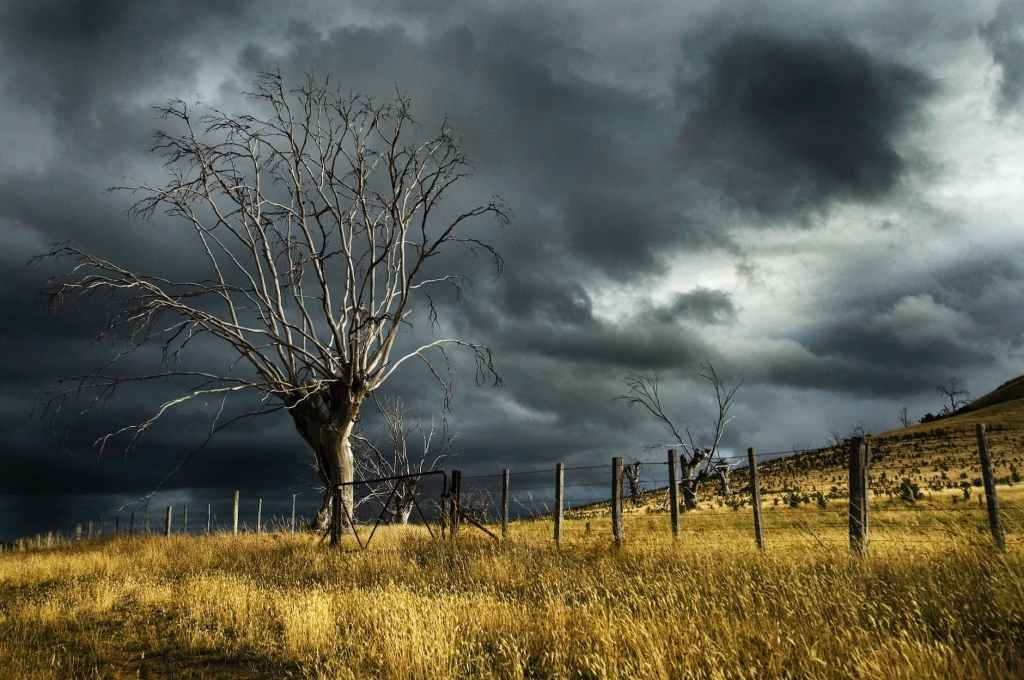
In Plainview you can see the storms coming for miles, and the one in ’86 took its time in getting to us. I was out getting baby formula (Lily had just been born) and I remember putting the bag in the trunk when I saw the dark clouds on the horizon, way out towards the hills. It was so strange, looking out there and seeing what was to come while the sun was still beating down us, a light September wind—I’d even burnt my shoulders that morning. I remember—I remember thinking about what the dinosaurs must have thought when they looked up and saw the meteor coming.
Back at the house, I saw Stan taking in the furniture from his porch next door.
‘’Lo, Stan.’
‘Howdy, Alan.’
‘Some storm coming.’
‘You got it. News says it’s gonna be a doozy. You and Deb gonna be okay? Little Lily?’
‘Yeah, we’ll be okay. You lookin’ forward to bein’ cooped up with Sarah for a few hours?’
‘Shh!’ He put his finger to his lips. ‘She’ll hear you. You wait ‘til you’ve been married twenty years, then you’ll see.’
‘Flash SOS in your window if things are gettin’ bad.’
‘Ha-ha.’
It’s funny the things you remember and the things you don’t. I know what we were watching on TV—a western—but I don’t remember when we decided that we all better go down to the basement; I just remember us being down there all of a sudden, like we teleported or something. I was leaning on the washing machine and looking at Deborah napping on the sofa we had down there, Lily nestled in her arms like a tiny animal.
The wind started getting crazy about an hour before the rains started. It started flowing around the thin panes in the basement windows, rattling like someone was shaking one of those Mexican drumstick things—I don’t know what they’re called. Shh shh shh.
We’d brought the TV down but couldn’t get a signal, so we listened to a little hand-crank radio until it cut out. Deborah had made turkey sandwiches, so we ate those and she fell asleep again. I had some knives to sharpen, so I did that while sat on the floor—my knees were still good back then. You know how it is.
When the rain started, it sounded like someone was throwing stones against the window. The wind was twisting around so much that the rain came in sheets, like there was a crop duster zig-zagging around the heavens.
Because of the noise, I didn’t notice straight away when Sarah started knocking on the basement window, and it scared me when I looked up and saw her pale face peering down at us, wet hair slapped across it. She looked like a demon. The girls were asleep, thank God. Sarah was wearing one of those bright yellow rain jackets and holding on for dear life. I motioned ‘upstairs’ to her and snuck out of the basement to avoid waking Deb or the baby.
She was struggling up the porch when I opened the front door, so I held on to the frame and reached out to her, yanking her in just before another gust could blow her away.
‘What in the fuck do you think you’re doing, Sarah?’
‘You gotta help me!’ She was sobbing. ‘It’s Stan; he’s gone!’
‘What’re you talkin’ about?’
‘He’s gone, you hear? We… we had a fight.’ I puffed out my cheeks. ‘He said he was goin’ for a drink. I told him there weren’t no bars open on account of the storm, but he just left anyway. I couldn’t stop him!’ She was heaving with it now and shivering, soaked through. ‘You gotta find him, Alan!’
‘He doesn’t… You didn’t… You didn’t tell him—’
‘Of course I ain’t tell him! Goddamn you, Alan, you son of a bitch! Get my husband back!’
I told her to go downstairs, and if Deb and Lily woke up, to tell them where I’d gone—but not why.
*
Later, the news said that there hadn’t been a tornado, but when I went out onto the porch I was nearly knocked off my feet, and in the distance, above the houses, I could see columns of cloud spiraling towards the ground, tens of them, and patio chairs were blowing down the street. I could barely keep my eyes open; it was like the winds were punching me, laying into me one after the other.
I tried to run to my truck, but a gale blew me back and into the side of the house; I found myself face-down in Deb’s rosebush, looking through the window into the basement. I saw Sarah and Deborah staring up at me, and Deborah’s face looked as bad as the thunder. I lay there for I don’t know how long, trying to get my breath back. Deb’s eyes seemed to be saying, ‘Don’t you stay out there,’ but there was nothing I could do. I pushed myself up, my hands slick with dirt and my arms scratched to ribbons by the thorns, and I crouch-crawled to the truck and opened the passenger door; it nearly blew off its hinges, but I managed to claw onto the handle and slam it shut after me.
The tempest was muffled inside the car, but it rocked from side to side like a cop car at a rock concert. I inched down the block, feeling like the storm wouldn’t see me, wouldn’t attack me, if I barely appeared to be moving. The radio was still on from earlier, but no signal was getting through, so the static mixed with the sound of the storm like waves crashing together. When I reached the turning at the end of our street, I turned slowly, foot by foot, praying that the car wouldn’t flip over. The wind changed rapidly, over and over, and I remember thinking that it was like being in a blender, and this thought made me long to be at home with my family, and for the first time that day I feared for my life—but I kept on going.
I didn’t see a soul until I got down to Arthur Avenue, and by then I must have been in the eye of the storm because suddenly everything became calm; it was dark, like dusk, even though it was only four in the afternoon or so, so it was hard to see much, but I spotted movement out of the corner of my eye. I eased off the gas and peered to the right, and only then did I notice that half the damn town had been ripped up already.
Morgan’s hunting goods was missing its roof, and the bars that hadn’t boarded up their windows were shells, the glass blown out and scattered across the sidewalk. I had to double take when I saw an upturned motorboat, kind of tan and orange, in the parking lot of the Blockbuster. It had no trailer; it was naked. It looked like it had been dropped straight from the sky. I edged closer to it in the truck and found what had caught my eye: a little gray-black dog (I couldn’t tell how old), its drenched wire fur sticking out like a punk’s, sheltering underneath the upturned boat, which was propped up by a fallen trash barrel.
I had my seatbelt off and was about to open the door when the wind picked up again. Debris from the street whipped up around the truck, and I watched countless beer mats from Petersen’s drift past me and down the street before the rain started once more, all at once like a faucet being turned on, and I stared into the eyes of this little dog, and I swear to God it never blinked. When I couldn’t bear it anymore, I started inching down the street again. I saw a dark cloud, impossibly close to the ground, spinning in my rearview, and the fear gripped me again and I put my foot down, praying, praying, and I didn’t look back until I’d gone about a mile.
For a moment I forgot why I was out there in the first place, and I cursed myself for not looking out for Stan’s car for the past couple of blocks. By now I was on the other side of town, so far from home, and the more destruction I saw, the more I worried for Deb, for Sarah, but mostly for little Lily, trapped in that basement, not knowing where her daddy was.
I’d started out looking for Stan near bars, like Sarah said, but there weren’t even any cars outside any bars that I could think of, and Stan must’ve seen Petersen’s blown out, and I started to panic. I started to think that maybe something really bad had happened here, maybe something that we couldn’t come back from, and then my mind ran away with itself, thinking about what Sarah might do—what she might say—if her husband was dead.
I was driving blind again—high-beams on to try and cut through the static. On the radio, indecipherable voices broke through occasionally, speaking in tongues. Coming out of town on the other side, near the Marshall farm, I saw a tree with all its leaves stripped off, its branches bent, torn and disfigured. I was about to turn around and retrace my steps when I spotted Stan’s Chevy parked outside the Marshalls’ barn, off the main road.
I always used to hear people describe wind as howling, you know—‘it’s really howling out there’—but I never understood what they really meant until that storm. The cacophony of it, the way that the air was shrieking around the truck, and how it would pick up out of nowhere and die down again, but the way it was now, on the other side of the eye of the storm, I’d never seen or heard anything like it. It makes you feel so small; we fool ourselves that we’ve mastered nature, that the earth belongs to us, but it’s bullshit. We’re just ants, truly.
I drifted down the dirt road, heading towards the barn, and just before I got there, the rear end of the truck got caught by an updraft and span me out. I was spinning in the mud there, I don’t know through how many rotations; it can’t have gone on for all that long, but I remember being terrified that I was getting sucked up into a twister, that I was going to get spat out miles up and miles away, and I’d come crashing down into an anonymous field and I wouldn’t be found for days. The only thing that happened, though, was that I crashed into Stan’s Chevy, just glanced into it, but it was enough to bring me to a halt. I was close to the barn door, the little one inside the bigger one, so I scrambled out, forced the truck door closed, and slipped my way, crouching like I was under fire, towards the barn.
The noise—my God, the noise. The rain was coming down again and it was washing the mud that my truck had kicked up off the barn like one of those pressure washers, just blasting the thing, while the ground boiled up under my feet, and I’m screaming, ‘Stan! Stan!’ And I’m hammering on the door like a maniac, feeling like I was going to get swallowed up whole. Finally, someone loosened the bolts and I fell though as the door was blown open, and I fell on the ground, lying there face-down, feeling as if I’d been thrown at the feet of Christ on the day of judgement, and when the door slammed behind me I should’ve thanked God or at least made a silent promise, but instead I said, ‘Stan, what the hell do you think you’re doin’?’
Even though I hadn’t seen him when I fell through the door, I knew who it was. His presence was heavy in the air, and while I lay there, staring into the dirt, I felt him looming over me like a tower. He didn’t help me get up, so I wiped my hand on my pants and creaked to my feet, feeling like I’d gone ten rounds with Foreman. When my eyes adjusted to the darkness, I could see an open space in the middle of the barn, scattered with hay, and fenced-off pens to the side. A pig’s snout stuck out of the gate to one of the pens for a moment before retreating into the blackness. I could make out a stack of hay bales as high as a house, and a ladder reaching up into the eaves high above. The rain was still loud in here, but not as ear-splitting. It felt like a sanctuary; matter of fact, it felt like a chapel.
I turned around, finally. Stan stood opposite me, unmoving, fists clenching and unclenching. When he saw me looking, he straightened up and stuck his hands in his pocket. I didn’t know what was going to happen, and to dispel the quiet I asked him again, ‘What the hell are you doin’?’
‘You wouldn’t understand,’ he said.
‘Fuck is that supposed to mean?’
‘Exactly.’ He brushed past me and started climbing up into the hay, lifting himself up from bale to bale.
‘Stan,’ I said, ‘you gotta come with me now. It ain’t safe here.’
‘Ain’t safe out there neither.’
‘I can’t hear you with your back turned.’
‘Cry me a river.’
‘What is your fuckin’ problem? Sarah’s worried sick about you out in this storm.’
‘Ah, we wouldn’t want that now, would we? Huh?’
I could feel my heartbeat in my throat. I caught myself shivering and realized that I was soaked through, rainwater and sweat mixing and drifting down my face and over my lips, into my mouth, the salt making me thirsty. I coughed and said to Stan, ‘You got any water?’
‘I got somethin’ to drink.’ He pulled a bottle of bourbon out from the hay and threw it at me—not to me, atme—and I caught it just before it hit the floor.
‘Jesus Christ, man. You’ve lost your damn mind.’
‘Drink it or don’t, I don’t give a shit. I ain’t goin’ out there and you’d best not neither.’
I went over to the door and put my ear against it, and from what I could tell, the weather was getting worse. The wood was stripping off the damn door, and I caught a splinter as I pushed away from it, so I swore, loudly, and tried to hold my hand up to the light as best I could. The splinter was under my fingernail; I could see it, maybe a centimeter past the nail, and when I pulled it out my eyes watered. I was going to say something to Stan, but then there was a creaking sound, like a ship turning, and then a ripping, twisting kind of sound, and I was looking around for it, worrying that the whole thing was gonna blow away, but tiles just started flying off the roof on the far side of the barn. Horses I hadn’t noticed until now started whinnying, and I was shouting, saying to Stan, ‘We gotta do somethin’,’ but then it stopped, or rather the wind started attacking the walls of the barn instead. It got quieter.
‘Fuck you,’ I said. ‘I got a wife and baby. If I die out here, I’ll kill you.’
‘Nice of you to remember ‘em.’
‘You got somethin’ you wanna say to me, Stan?’
I saw Stan peering down at me, his backlit face a black hole, and he just said, ‘What fuckin’ difference would it make?’ I couldn’t think of anything to say to that, so I just opened the bottle and started drinking.
The time passed slowly at first, and I couldn’t sit down—didn’t want to climb up to join Stan—but all of a sudden night fell, and the storm hadn’t let up.
‘You think we’re gonna make it out of here tonight?’
‘Ask the weatherman,’ said Stan. ‘I ain’t know.’
My dogs were barking, so I folded and clambered up the hay bales, stopping one below Stan and leaning up against the one behind. The hay stuck into my back, so I smoothed it down with my chapped hands. It was freezing. I asked Stan for the bottle again and he leaned down and passed it to me wordlessly. There was more thunder than lightning, but every now and then a flash would ricochet through the holes in the barn roof and illuminate the inside, revealing the pigs and horses, sheep huddled together, sleeping, in alcoves. Everything smelled of wet and dirt. I couldn’t bear the silence between us—that was the worst thing—but anything I was going to say sounded pointless in my head. The last thing I remember saying was, ‘Ain’t none of us perfect.’ If Stan heard me, he didn’t say anything about it.
*
I woke with my head on Stan’s chest, lying next to him at a right angle, and I thought maybe I’d been injured until I remembered that we’d been drinking all night, drinking ourselves into unconsciousness, the only way we’d get any rest. I sprang up off Stan’s chest and wiped my eyes. The bottle had fallen in the night, whatever was left of the contents having trickled down into the hay. Sunbeams streamed through the holes in the roof and I could see all the animals sleeping, horses curled together in dreams. I turned around again to see Stan on his elbows, not looking at me, and I wondered whether he felt shame or just anger. ‘Let’s go,’ he said.
Outside, the sky felt foreign, clear blue and not a cloud in sight. I took my jacket off, my filthy shirt already starting to cling to me in the heat. All around us was the clutter of the storm—fence posts that had been ripped from the ground, deck chairs and lawn furniture and indeterminate debris, planks of splintered wood that could’ve been anything at all. The majesty of the sunshine felt profane, shining on the almighty mess that the storm had kicked up.
‘I’ll follow you,’ said Stan, and he got in his Chevy, its door scratched up by my collision with it, and reversed to let me out. I climbed into my truck and started it up.
*
I wanted to go fast on the way back home, but my foot refused to lie heavy on the gas pedal; I kept getting distracted by the sights along the way. There were fallen power lines everywhere, drooping down across the streets like black spaghetti. We were nearing Arthur Ave. before I noticed that one of my wing mirrors was smashed.
The thing that got to me most—the thing I still can’t understand, to this day—was how some houses were completely destroyed, hollowed out, demolished, while others stood proudly on the street, bathed in sunshine, like they had been chosen, spared. There was no sense to it. People began to emerge from their basements, blinking into the light. I saw a woman cross-legged on her porch, shell-shocked, the only remains of her house being the door frame and a staircase that now led to nowhere, just more blue sky.
We had to take a detour around Baker Street because one of the old oaks in the neighborhood had come down across the road, crushing a Pontiac on the other side of the street. My hangover receded into blind panic. On some streets, the destruction seemed to alternate—one house fine, the next annihilated—and I was praying again for Deb and Lily. I’ve never been as scared as when we turned into our street.
The house was fine. Not just ours, but Stan and Sarah’s too. Our street escaped the worst of it; there was no-one standing outside their houses. They were in bed, maybe, sleeping through everyone else’s nightmare.
We pulled into our driveways. I turned my engine off while Stan let his idle. I got out, feeling lightheaded, and Deb came streaking out of the house with Lily in her arms, and she was saying ‘Oh thank god, thank god,’ with tears streaming down her cheeks, and she said, ‘Daddy’s home, baby, oh thank god, thank god,’ and she wrapped me up in her arms, Deb, Lily and me, and I wasn’t crying, but I could’ve, I swear.
Over Deborah’s shoulder, I watched Stan get out of his Chevy. Sarah was standing on their porch, clasping her hands together; he walked straight past her, not even looking at her, not even saying a word.
 Luucid