
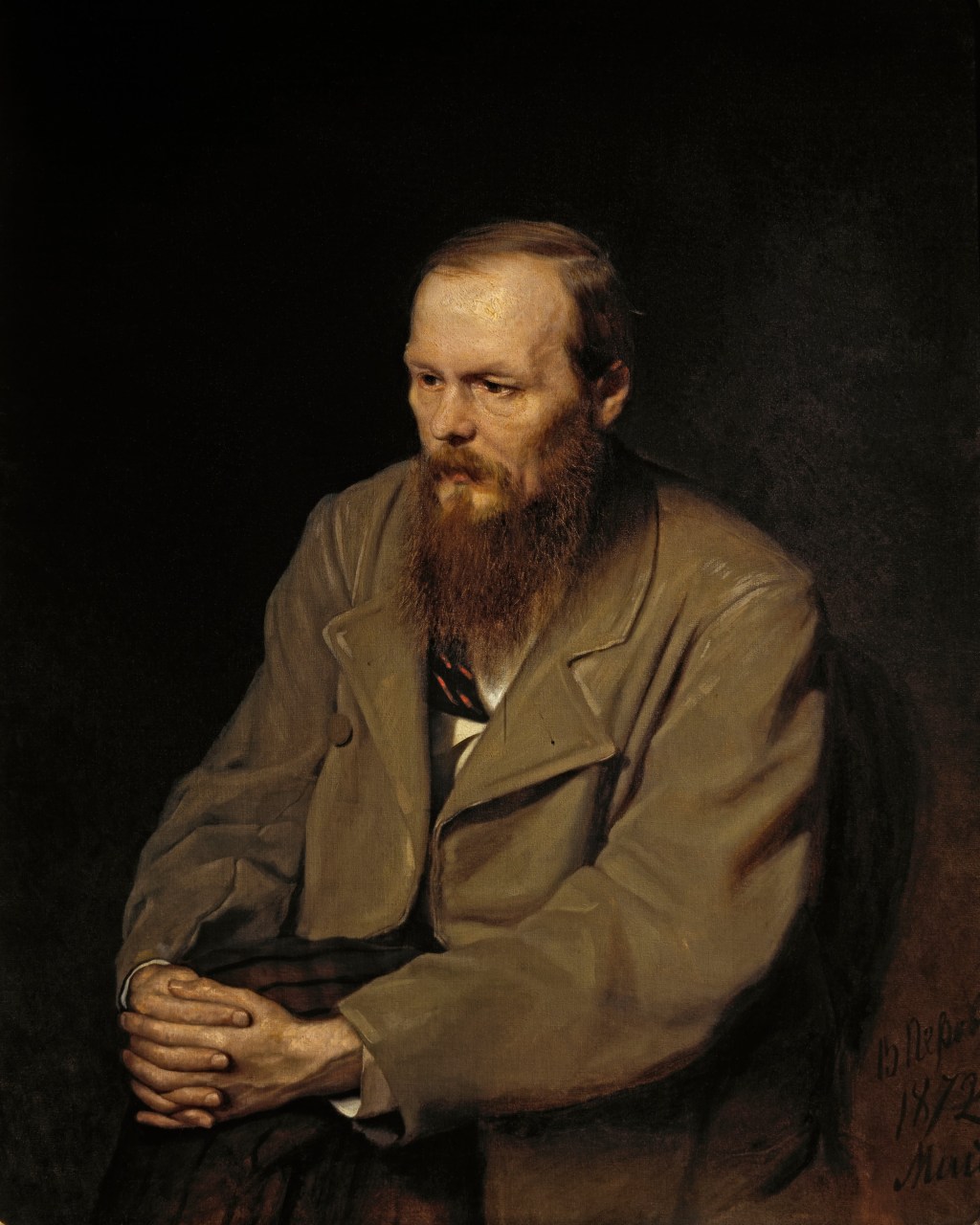
‘Beauty will save the world!’
Prince Myshkin, The Idiot
The Idiot was written in 1869, and despite it being one of Dostoyevsky’s most personal works, it also thoroughly reflects its time. There are references to Napoleon, the slow death of the Russian aristocracy (paving the way for the revolution), and theology, with Dostoevsky’s anti-Catholicism also shining through.
The novel’s central theme is that the purest among us are often the most derided, mostly due to the absurdity of a class-based society. Specifically, Dostoevsky records the decay of Russian high society. The characters are conniving, devious, and generally unpleasant to each other, and their transgressions generally go unpunished. Hardly any of them have what we would recognise as a ‘proper’ job. The only working man, a civil servant named Lebedev, is portrayed as a leech, an insufferable sycophant, and an alcoholic.
The novel introduces the titular idiot, Prince Myshkin, as a debilitated epileptic. His illness has caused him to lose out on a formal education and become ostracised from society. We open with the Prince returning to Petersburg (modern-day St Petersburg) from Switzerland, where he’s been receiving treatment.
The Prince falls under the care of a distant relative, Lizaveta Prokofienvna, who is married to a well-respected General and a member of the upper middle classes. It emerges that the Prince’s benefactor has left him a great deal of money in his will, which becomes a matter of contention over the next 500 pages.
The novel is perhaps most famous for the inclusion of the character Natasya Fillipovna, the most beautiful woman in all of Petersburg—a sort of femme fatale. She was adopted by an aristocrat after her own family died, and this man groomed her for his sexual gratification for several years. Shamed away from this, he has now agreed to arrange for her to be married to the highest bidder. The ensuing tug of war draws together Natasya, the Prince, and Rogozhin, a roguish young man who has recently come into a large inheritance himself.
With the character of the Prince, Dostoevsky asks if a purely good man can survive in these morally bankrupt surroundings. Myshkin is eventually destroyed by his devotion to Natasya Fillipovna, who, while undoubtedly a victim, is one of the cruellest players in this satire.
But is the book actually any good? Can modern readers truly appreciate it, or is The Idiot a relic? There are certainly timeless literary devices at work here (not least the love triangle), but these all feel superficial given Dostoevsky’s ambition for the novel to be his greatest work. On the other hand, there are several passages of interest in terms of Russian history, but the reader has to persevere beyond many pages of insipid melodrama played out in Petersburg high society.
Dostoevsky later admitted that The Idiot is much too long and rambling, a criticism that is probably justified. Personally, I wish that I’d read Crime and Punishment first, as it’s generally understood to be Dostoyevsky’s best—and is, by all accounts, a far more forgiving read.
 Luucid